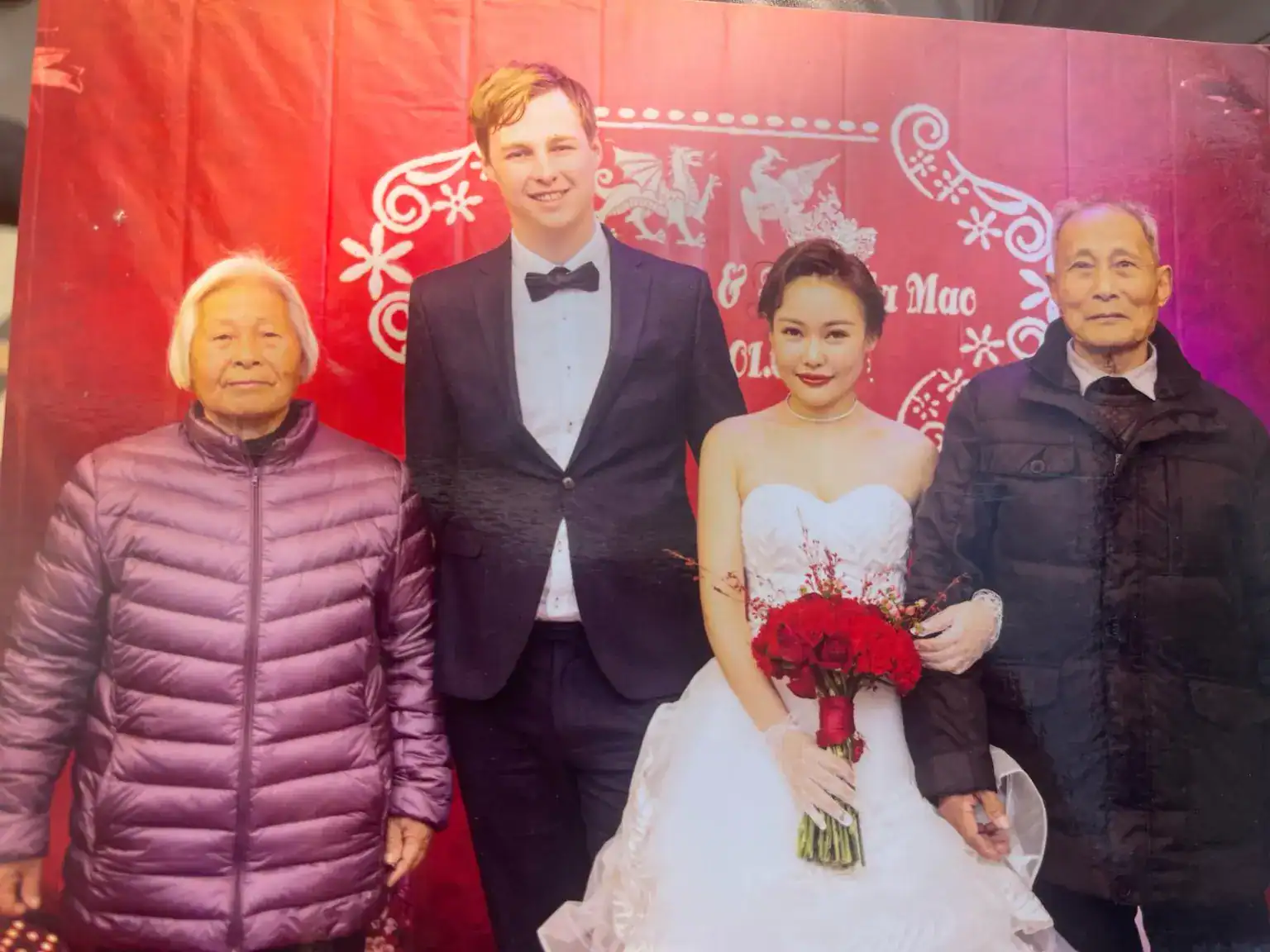
Chris Foley has set himself a challenge to improve his tone pronunciation and achieve a standard Mandarin accent in time for his Chinese wedding ceremony in one year. To reach his goals, he’s enlisted I’m Learning Mandarin founder, Mischa, as his language coach. In this post, he reflects on his journey over the past 6 months towards recording his first-ever interview entirely in Mandarin (watch above).
(Read month one, month two, three, and four/five of Chris’s diary.)
Reaching the halfway point of this year-long project has been a good chance to pause and reflect. The first few months were about laying the foundations. This month marked a shift towards speaking more freely and being tested in a very public way.
A new focus
Up to now, most of my time has been spent re-learning and reviewing the basics: tones, pronunciation, and sentence structure. That work was essential, and I still rely on it every day. But over time, I started to feel the limits of what controlled practice could do on its own. This month I began to focus more deliberately on producing full sentences in natural speech — not just repeating phrases or reading from a script, but trying to express my own thoughts aloud in real time.
This has turned out to be one of the hardest parts of the process so far. When I isolate words, I usually get the tones right. But as soon as I start speaking more freely, I tend to revert to old, fossilised mispronunciations. I know what the tones should be, but in the moment, they don’t always come out correctly.
Preparing for the interview
From the beginning of this project, Mischa and I agreed that I’d record a short podcast interview at the six-month mark. That gave me a clear goal to work towards and a useful sense of pressure. I knew it wouldn’t be perfect, but I wanted to be able to get through a conversation in Mandarin without falling apart.
In the weeks leading up to the recording, I changed how I was studying. I spent more time each day speaking out loud — sometimes practising set topics, sometimes just narrating whatever was in front of me. I also listened more closely to native speakers, trying to get a better sense of natural rhythm and phrasing.
Speaking under pressure
When the day came to record, I was definitely nervous. Speaking Mandarin on camera, knowing the video would be made public, felt like a much bigger step than our usual practice sessions. But we got through it. I didn’t say everything I wanted to say, and there were plenty of small errors, but I managed to comfortably hold the conversation in Mandarin from start to finish.
Afterwards, Mischa and I watched the recording together and talked through some of the issues. The usual problems showed up - inconsistent tones, unnatural phrasing in parts - but it was also clear how much things had improved. Compared to where I was a few months ago, it felt like a massive step forward.
Looking ahead
The next phase of this project is about building on that base. I still have a lot of work to do on tone accuracy, especially in fast or spontaneous speech. I also want to develop a more natural-sounding rhythm. And as the topics we cover get more complex, I’ll need to keep growing my vocabulary to match.
At the end of twelve months, I’ll be recording another podcast interview to show how far I’ve come. That’s a slightly daunting thought, but also a helpful motivator, as I’ll really have to push for further improvement to demonstrate progress.
I’m really happy with how far I’ve come since starting this process. There’s still a long way to go, but reaching the halfway point has definitely made the progress feel real.