A number of influencers claim to have mastered Mandarin within just six months. But is this really possible? And just how long does it actually take to learn Chinese?
Table of Contents
- Introduction
- Is Mandarin Chinese Hard to Learn Compared To Other Languages?
- How Long Did It Take The Best Mandarin Speakers To Learn Mandarin?
- How Long Does it Take to Reach an Intermediate Level of Mandarin Chinese?
- How Long Does it Take To Reach an Advanced Level of Mandarin Chinese?
- How Long Does It Take to Reach a Native Level of Mandarin Chinese?
- Conclusion
Introduction
Recently I watched a YouTube video which got me thinking about the question: how long does it take to learn Mandarin? The video, which was originally titled “How I Mastered Chinese in Six Months” but has since changed its title to ‘learned’, has done pretty well – as videos with enticing titles often do – amassing nearly a million views.
It begins with a clarification. The vlogger admits that by “mastering” or “learning” the language she is referring to passing the HSK4 proficiency exam – a significant achievement but somewhat short of basic fluency, as I discuss in this blog.
Predictably the video has provoked an online backlash, with some seasoned learners on Twitter pointing out that the title is at best grossly misleading and, at worst, a downright lie. Moreover, this is not an isolated example, but rather part of a wider genre of content that suggests learning Chinese to a high level in half a year – or even less – is possible.
In another popular post called “How I Learned to Speak Mandarin in 6 Months,” a blogger makes an even bolder claim. Within half a year she went from having no knowledge of Mandarin to being able to speak fluently at the level of an average middle school student.
Some claim it’s better to exaggerate the ease and speed at which Chinese can be acquired because this gives learners an incentive to keep studying. I disagree.
Many learners who are sold the dream they can master Mandarin quickly give up when the reality doesn’t match their expectations. I think a better approach is to start out with a realistic idea of the time commitment learning Chinese requires.
So how long does it actually take?
Is Mandarin Chinese Hard to Learn Compared To Other Languages?
The first place many people go in search of an easy answer to this question is the Foreign Service Institute’s language difficulty ranking estimates.
The FSI ranks languages by the approximate time it takes for an English speaker to reach ‘general proficiency’ in speaking and reading. It splits the world’s languages into four categories 1-5 (ranked easiest to hardest).
According to these rankings, the easiest languages, like French, Spanish, and Italian (category 1) typically require around 600-750 hours of study. German is slightly harder, needing about 750 hours (category 2). Indonesian, Swahili, and Malay are next, requiring around 900 hours (category 3). Then we have Russian, Greek, and Turkish at 1100 hours (category 4).
Finally, we come to the hardest languages which are the most distant from English in their grammar, written form, and pronunciation. These include Mandarin Chinese, Arabic, and Japanese which the FSI estimates require 2200 hours of study.
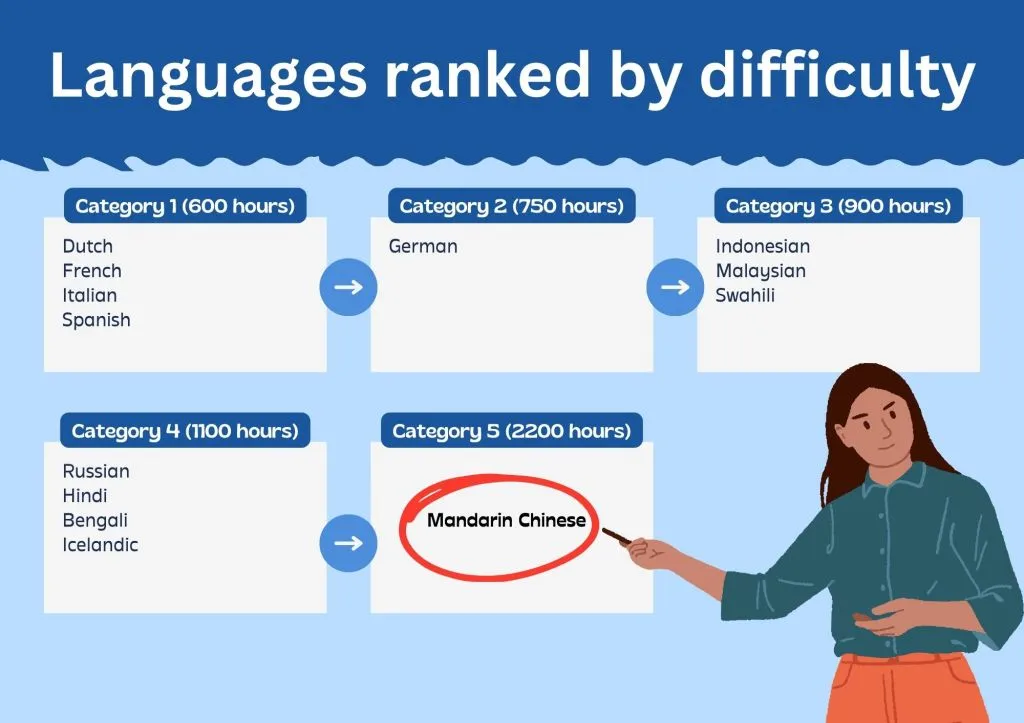
Given that there are around 183 days in six months, if we accept the FSI’s figures, you would need to spend 12 hours a day studying Mandarin in order to reach ‘general professional proficiency.’
12 hours a day would certainly be pretty extreme, though perhaps not beyond the realms of possibility.
But there are some problems with these estimates. Firstly, it’s not clear what specifically students are meant to be doing within those 2200 hours. And when studying a language as different from English as Mandarin Chinese, methods matter.
Clearly, a student who spends 2200 hours learning to write Chinese characters out by hand or using Duolingo will not become fluent in spoken Mandarin unless they also spend many hours using more efficient methods.
It’s also not clear whether or not the FSI has based its estimates on real-world examples of students becoming proficient in Mandarin within certain time frames.
So rather than tackle this question in the abstract, perhaps a better question to ask is:
Has anyone ever learned Mandarin to a high level of proficiency within six months?
After all, what does it mean to say that it’s possible to achieve something if nobody in the real world has ever actually achieved that thing?
Three Real-Life Case Studies

Here I’m in a good position to contribute to the discussion. Although I didn’t become fluent in Chinese particularly quickly, I’ve interviewed some of the world’s fastest Mandarin learners for my podcast.
Let’s take a look at three case studies of super learners who have achieved varying degrees of Mandarin proficiency within unusually short periods of time and can give us an idea of what’s possible with the right methods and circumstances.
Case Study 1: Will Hart
Will Hart is probably the case I know the best, having documented it in-depth in this blog. Will began learning Mandarin during the lockdown, initially having short structured conversations with his Mandarin-speaking friend and drilling Anki flashcards.
He later moved to the University of Manchester to study medicine where he was surrounded by Mandarin-speaking international students and found himself completely immersed in the language.
After one year, Will uploaded a short video of himself speaking Chinese with excellent pronunciation. After 1.5 years, he had reached a level of conversational fluency that was almost indistinguishable from a native speaker. He was also able to read Chinese characters, although his reading abilities lagged behind his oral skills.
To date, I have yet to come across a case of a learner reaching high level spoken fluency as quickly as Will did.
Case Study 2: Professor Karen Chung
Professor Karen Chung is a professor of linguistics who began learning Mandarin as a student in the 1970s in Minessotta. She found herself surrounded by Taiwanese students at university and spent most of her time outside of class socialising with them.
One friend in particular was very helpful, patiently correcting her on all her mistakes. It was the perfect marriage of formal study with social connection and her progress was very swift.
As she told me when I interviewed her on my podcast, “In two and a half years, I could pretty much handle most stuff…you have to be just so in love with it and so crazy about it and so dedicated that you work at it all the time.”
After moving to Taiwan in the 1970s, Professor Chung has continued living there ever since. She is a rare case of a non-native speaker who has reached a true native level.
A few years ago a Ted talk (above) she delivered in fluent Mandarin went viral in Taiwan, with commenters marvelling at her eloquence and native pronunciation.
Case Study 3: Steve Kaufmann
Steve Kaufmann is a YouTuber and polyglot who speaks 20 languages. In the 1960s he trained to be a diplomat with the Canadian Foreign Service.
He was sent to Hong Kong where he studied Mandarin for a year and, according to his own account, would spend up to eight hours a day practicing Mandarin using reel to reel tapes and graded readers.
Within six months of study, Kaufmann was able to read his first proper novel. After a full year of study, Kaufmann had achieved a level of spoken fluency that enabled him to handle himself in most situations.
Kaufmann’s case is slightly different from Will and Karen’s in that he’s not in the business of ‘mastering’ languages, preferring to reach an intermediate level in many languages rather than a highly advanced level in one.
At his best, his level could not be described as ‘near-native’. But the speed at which he acquired Mandarin is up there with the fastest I’ve come across.
How Long Does it Take to Reach an Intermediate Level?
So, in the best-case scenario, how long does it take to reach an intermediate level in Mandarin Chinese?
Well, below, I’ll summarise what I think is the best-case scenario, based on my own experience, the FSI estimates, and the real-world case studies above.
However, it’s worth bearing in mind the example I give below is extreme and many learners who study at a pace several times as slow will still find the experience highly intensive and challenging.
Suppose a student (let’s call him Bob) is an experienced language learner who has never been exposed to Mandarin before. He uses the best available methods from the start, is solely focused on studying Mandarin for eight hours a day, is fully immersed in the language environment, and has a knack for picking up aspects of pronunciation other students find difficult, such as tones.
Under these rare conditions, I think Bob can begin approaching an intermediate level of comprehension within 6 months. At this point, he will have studied for around 1500 hours – somewhat short of the 2200 study hours that the FSI estimates is necessary for native English speakers to reach ‘general professional proficiency’.
As mentioned above, at the half-a-year mark polyglot Steve Kaufmann began to labor his way through novels, making out the plot despite encountering a high proportion of unknown words. Bob might start attempting his first novel too, and he may also be capable of passing the HSK5 proficiency exam.
He should be able to handle most of his day-to-day needs in Chinese and function in extended conversations, providing comprehensible responses to fairly simple questions while making many mistakes.
As soon as the topic ventures into unknown territory, however, Bob’s comprehension skills will fall off a cliff. A lot of TV and radio content will remain immensely challenging and it will be difficult to understand more than the gist of many current affairs radio programmes. Bob should have more luck following the predictable plot of a romantic TV drama.
But if he’s honest with himself he will admit he’s nowhere close to “fluency”, let alone “mastering Chinese”.
How Long Does it Take To Reach an Advanced Level?
Continuing at the same extreme pace, a more advanced level of fluency can be reached after 12 months. Bob will speak clearly and have no issue making himself understood for most ideas he wants to communicate. He will still make many mistakes and his use of words will sometimes be awkward and unnatural.
Bob will be able to read some modern novels without much difficulty, watch popular movies without losing the plot, and might even pass the HSK6 proficiency exam.
However, he will continue to struggle when it comes to a huge range of topics all educated native speakers have little difficulty comprehending, from nature documentaries to the news.
In short, in the best-case scenario – so rare as to be practically irrelevant to the circumstances of most learners – I believe it’s possible to reach a solid intermediate to lower advanced level of fluency in Mandarin within a year.
While Bob would be justified in claiming to be ‘fluent’ - and many people might consider his level more than sufficient for their needs - it would remain a stretch to say he’d mastered Chinese.
Bob will still struggle to express himself on many topics outside of everyday life which would pose no problem at all for him in English, for example, popular science and current affairs.
Moreover, a stricter definition of “mastery” would require comprehension and speaking skills approaching those of an educated native speaker.
How Long Does It Take to Reach a Native Level?
How long, then, would it take to achieve a native level?
Here it becomes more difficult to put a time frame on it, though it’s certainly not possible to achieve within a brief period.
I estimate that reaching a point where a student can switch on the TV and understand all content – including the news – with an ease rivaling that of an educated native speaker may require over a decade of fully immersed study.
Bob would need many years to acquire enough cultural and historical awareness (as well as knowledge of classical Chinese) to catch up with native speakers who have, after all, been through decades of a rigorous and demanding education system.

A further problem for Bob is that formal Chinese vocabulary used by news anchors differs significantly from everyday Mandarin – far more so than in English. The highly experienced polyglot Vladimir Skultety reports that it took him a full eight to nine years of intensive learning before he was able to understand Chinese news comfortably.
There are of course examples of foreign Chinese speakers who have reached something like native proficiency in all areas of the language. The most famous case may be the Canadian comedian 大山. In fact, many of my Chinese friends tell me he expresses himself better than an average educated native speaker. Perhaps he can provide us with an answer.
大山 began learning Chinese in 1984 and his pronunciation and vocabulary have continued improving toward native proficiency right to the present day. Therefore if we use him as a benchmark we can conclude that it takes at least 38 years to master the Chinese language!
Conclusion
But the real answer, of course, is that nobody – not even native speakers – ever fully masters Chinese. Part of the beauty of taking on the language is that there is always more to learn. More vocabulary, more dialects, and a deeper knowledge of classical Chinese.
In the long run, embracing this fact – rather than searching for tempting quick fixes – is the psychologically healthier and more sustainable option.
That’s not to be pessimistic, though. The good news - as the case studies highlighted above demonstrate - is that anyone who really dedicates themselves to learning Chinese full-time can, with the right methods, achieve incredible things within one year of study.