This week on the I’m Learning Mandarin podcast, I discuss how you can use Deepseek as a game changing tool to become fluent in Chinese.
As we’ve previously covered on this blog, while tools like ChatGPT are helpful for various aspects of Mandarin learning, they often fall short when it comes to generating truly natural, colloquial speech. .
This is because their training data seems to be heavily weighted towards more formal, sometimes translated sources.
Native speakers often point out that while ChatGPT’s Mandarin is usually grammatically correct, it just doesn’t sound like how real people talk.
That’s where Deepseek, the Chinese version of ChatGPT, really excels.
Despite some of its limitations, such political censorship and data concerns, there is no doubt that it excels at generating authentic spoken Mandarin, which is exactly what we Mandarin learners need when it comes to improving our conversational skills.
So, how can you effectively use Deepseek to level up your spoken Mandarin?
Below is the the simple three step process I recommend:

1. Start by writing your own text in Mandarin.
Have a go at writing a paragraph of text explaining an idea, expressing an opinion or telling a story as if you were talking to a friend in Mandarin.
Don’t worry if it’s not perfect! I recommend trying to express your thoughts directly in Chinese rather than translating from English .
This forces you to engage with the language actively and makes it more likely that Deepseek will refine existing Chinese into something natural, rather than just providing a potentially less natural translation.
If your Mandarin is at an intermediate level and contains unnatural phrasing (or “Chinglish” as some might call it), Deepseek will likely understand your intended meaning.
2. Prompt Deepseek to make it sound natural
The key here is to instruct AI to transform your written Mandarin into the kind of language a native speaker would use when chatting informally with a friend.
Here’s a screenshot of an example prompt where I deliberately used intermediate learner style Chinglish and asked Deepseek to turn it into natural spoken Chinese.
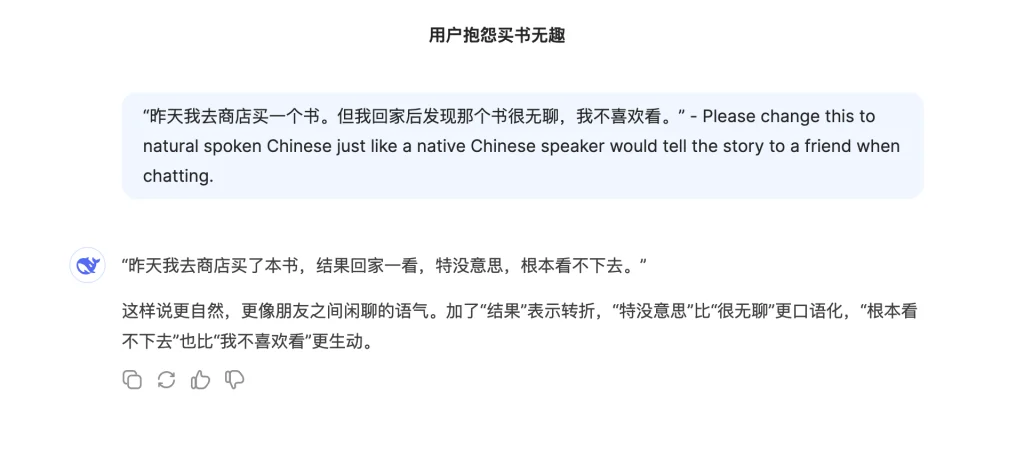
The prompt I used in the podcast and which you can copy if you like was:
“Please change this to natural spoken Chinese, just like a native Chinese speaker would tell the story to a friend when chatting.”
Be specific about the context – a casual conversation between friends – to guide Deepseek in generating the right kind of language.
You’ll see how Deepseek takes your original text and rephrases it in a much more colloquial and natural way while keeping the meaning intact.
This gives you an immediate insight into how native speakers would actually express those ideas.
3. Get a native speaker to record Deepseek’s output
While Deepseek generates natural-sounding text, hearing it spoken by a native speaker is invaluable for mimicking the correct pronunciation and intonation.
This also provides you with a high-quality audio file of the exact sentences and phrases you want to learn.
You can then collect these audio files and listen to them on repeat to internalise the correct sentence structures and pronunciation.
Here’s an example of an audio file I made a few years ago with my tutor:
By repeatedly listening to the audio recording and mimicking the native speaker’s pronunciation and intonation, you’ll start to internalise native sentence structures and patterns for the things you want to say.
This method allows you to immerse yourself in personalised content that focuses on your specific communication goals.
Game Changer for Mandarin Learning

I believe Deepseek could be a game changer for Mandarin learnering.
In the past, generating this kind of natural audio content would take a significant amount of time and effort.
Now, it can be done in a matter of minutes. If this technology had been around when I was at that stage, I have no doubt that it would have accelerated my progress significantly.
So, I highly recommend giving this method a try with longer paragraphs of text on topics you’re interested in discussing.
If you make this a regular part of your study routine, I guarantee you’ll see a major impact on your ability to express yourself naturally in Mandarin.
How about you?
Do you use Deepseek to learn Chinese? If so how do you use it? Please share in the comments!