Last week a friend in the UK who is at a higher elementary level of Mandarin was telling me about an experience he had while walking the dog in the park.
As he was strolling past a group of Chinese students he noticed them looking and pointing enthusiastically at his dog. My friend decided this was the perfect opportunity to practice his Mandarin and after composing himself and thinking it through he mustered up the words “你觉得她可爱吗?” (do you think she is cute?).
Due to the slow, lumbered nature of his delivery, it was not immediately obvious to the students that he was actually speaking Mandarin. However, after a few seconds, they were able to work out what he had said and reacted in a fashion most Mandarin speakers would be familiar with. He was showered with compliments, told his Chinese was extremely well spoken and asked if he had ever been to China.
From the way my friend told the story it was obvious he found the experience thrilling. This made me feel nostalgic for a time when I used to enjoy such encounters. At a lower level I would seek out these interactions, surprising Chinese people with basic phrases and then basking in the glory of their responses.
However, I have long since grown tired of this game. Ironically, as the frequency and enthusiasm of the praise has grown, my desire to be complimented on my Mandarin has decreased to the point where I would rather not receive compliments at all, however well-meaning. There are several reasons for this.
One factor is that my motivations for continuing to learn Chinese have nothing to do with impressing people. I want to engage in interesting conversations, explore Chinese culture and read interesting literature. These dramatic displays often feel like a barrier to genuine interaction. You are constantly treated like a strange performing monkey rather than someone who just wants to have a normal conversation.
I have also become more aware of the cultural background underlying this praise-giving, including how Chinese politeness works (a topic I recently recorded a podcast episode on) and the real meaning behind the complimentary phrases that come up repeatedly.
When Chinese people say “你的中文超级好。真的!” (your Chinese is excellent! Really!) They often miss out the crucial words: “…for a foreigner.” If they add in these words, and we reflect for a moment, we can conclude this is the lowest of all imaginable bars. More than 99% of British people can’t speak a single word of Chinese. Anyone who learns to mispronounce 你好 after a single introductory class thus qualifies as a recipient of such praise.
As I progress to a level where I can converse with some fluency, speak clearly and be understood I’m frequently told by Chinese people that I’m the best foreign speaker of Chinese they’ve ever met. This used to be a real ego booster. That was before I began asking the awkward follow-up question: “How many foreign Chinese speakers have you ever met?” The answer is usually fewer than five.
I recently tweeted about an encounter with a waitress in a Chinese restaurant who interrupted my conversation with a friend to tell me how amazing my Chinese was. We interacted for several minutes and she appeared dumbfounded, as though the shock of hearing a foreigner speak such flawless Chinese might give her a heart attack. She then turned to my Chinese friend and revealed what she really meant: “It’s incredible! I can actually understand him!”

The exaggerated and overwhelming nature of these compliments is understandable given how few people in the Western world speak Mandarin. But it can actually create serious barriers to progress. To improve your language skills it is essential to know what your weaknesses are. With a language as different from English as Mandarin, these weaknesses are often blind spots which need to be pointed out to us by native speakers.
Unfortunately, many Chinese people, including tutors, are too polite to offer honest feedback. This leads to many learners remaining in a permanent state of egotistical limbo - believing the hype whilst remaining unaware of their shortcomings and therefore failing to ever improve. This is why it’s common to hear popular YouTubers incorrectly refer to themselves as possessing a “native” or “near-native” Chinese level.
Native-level foreign Mandarin speakers do exist, but they probably account for less than a tenth of the internet stars who boast of being at that level. In many cases these influencers aren’t exactly lying, they genuinely believe it because they’ve been told it so many times by multiple native speakers. I’ve even been told this myself more than once.
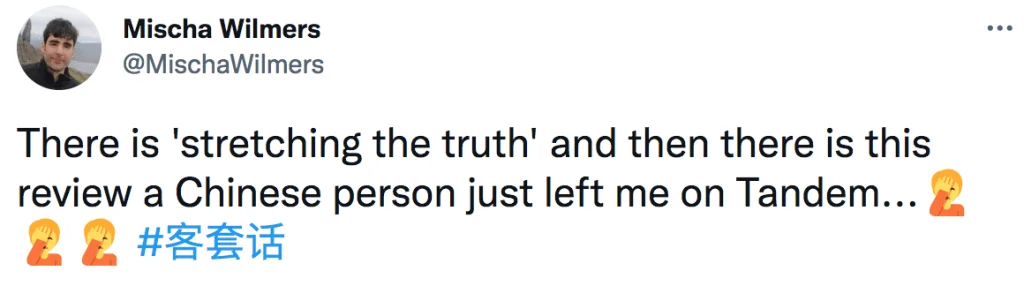

I must confess, as an inexperienced language learner I too was prone to believing the praise was real. Fortunately for me, each time my ego gets carried away with itself one of the honest friends I make sure to surround myself with brings me crashing back down to earth. When I receive praise from strangers now I take it for what it is. I know that it says nothing about my true level.
Instead, these compliments serve as a constant reminder of how far I have to go before my Mandarin reaches a level that deserves to be spoken about in glowing terms and, more importantly, that would satisfy me personally.